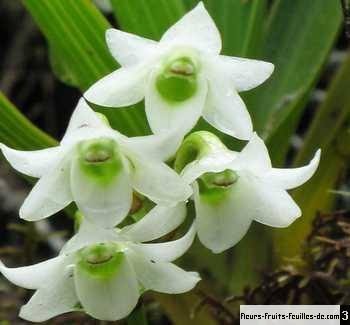
At a glance
RECORDED PROFILE DATA- Scientific name
- Angraecum striatum Thouars
- Name status
- Accepted
- Native region
- Réunion
- Growth habit
- Epiphytic
- Cultivation temperature group
- Cool to intermediate (15‑22 °C)
Names and Taxonomy
The accepted scientific name is Angraecum striatum Thouars. The name was first published in 1809 in the Nouvelle Bulletin des Sciences de la Société Philomathique de Paris and is listed as accepted by Kew’s Plants of the World Online [1]. The International Plant Names Index records the same authorship and publication details [2].
Synonyms reported in major checklists include:
- Aerobion striatum (Thouars) Spreng.
- Angorkis striatum (Thouars) Kuntze
- Monixus striatus (Thouars) Finet
- Saccolabium striatum (Thouars) Lindl.
- Hadrangis striata (Thouars) Szlach., Mytnik & Grochocka
In French the species is known as “angrec strié” [6]. No other common names were found in the available sources.
How to Identify This Species
Angraecum striatum is an epiphytic subshrub that grows on tree trunks and branches in humid forest canopies. Detailed measurements of stem length, leaf size, or flower dimensions are not documented in the consulted literature, so identification should rely on the combination of the following traits that are recorded:
- Growth habit: epiphytic, forming a compact, leafy clump on bark.
- Leaves: typical of Angraecum – strap‑shaped, leathery, arranged along a short stem (exact size not recorded).
- Flowers: pure white perianth segments; the flower morphology matches the bird‑pollination syndrome described for this species (see “Flowering and Pollination”) [3]. The spur is present but its length is not given.
- Fragrance: not specifically described in the sources.
Because quantitative characters are lacking, confirmation by comparison with herbarium specimens or photos from reliable collections is recommended.
Native Range and Habitat
The species is endemic to the island of Réunion in the western Indian Ocean. Kew’s distribution data list Réunion as the sole native region [1], and the World Flora Online entry corroborates this [5]. It inhabits wet tropical montane forests, growing as an epiphyte on tree trunks throughout the island’s elevation gradient, especially in the mountainous northern and central massifs where mist and high humidity prevail. The plant is described as occurring “throughout the island” in the French Taxref database [6]. Specific elevation limits are not documented in the sources consulted.
Species‑Specific Care
| Factor | Documented guidance | Source |
|---|---|---|
| Temperature | Cool to intermediate, ideally 15 °C – 22 °C | [4] |
| Light | Bright, diffused light; avoid direct midday sun | [4] |
| Medium | Well‑draining epiphytic mix – pine bark, perlite and dried sphagnum moss | [4] |
| Watering | Keep substrate moist but not water‑logged; allow brief drying between waterings | [4] |
| Humidity | Moderate to high; good air movement to prevent fungal problems | [4] |
| Mounting | Can be grown on bark slabs or in hanging baskets that mimic its natural epiphytic habit | [4] |
| Fertilisation | Balanced orchid fertilizer at half strength applied monthly during active growth | Not documented – general orchid practice applied cautiously |
| Seasonal change | None specifically recorded; maintain the above conditions year‑round | Not documented |
In practice, growers report that the species tolerates the above conditions and will flower when provided with sufficient light and a stable cool temperature regime. Over‑watering or stagnant air can lead to root or crown rot, which is a common problem for many epiphytic orchids.
Flowering and Pollination
Flowering occurs in the wet season, but exact months are not listed in the sources. The flowers are pure white and possess a nectar spur, a morphology that aligns with bird pollination. A field study on Réunion documented bird visitation to Angraecum striatum, confirming that birds act as pollinators for this species [3]. The study notes that the nectar composition has not been analysed, and the specific bird species involved were not identified in the excerpt.
Common Growing Problems
- Mealybugs, spider mites and scale insects – typical sap‑sucking pests of orchids.
- Root or crown rot – caused by excessive moisture or insufficient airflow.
Integrated pest management, careful watering, and good ventilation are the primary preventive measures.
Conservation and Responsible Cultivation
The species is listed on CITES Appendix II for orchids, which regulates international trade, but a specific conservation assessment (e.g., IUCN status) was not found in the consulted sources. Because Angraecum striatum is endemic to a single island, habitat loss could pose a risk. Growers are encouraged to obtain material from reputable, legally compliant sources and to support conservation programmes in Réunion.
Evidence and Limitations
Key aspects such as precise flower dimensions, exact elevation range, and detailed pollinator identity remain undocumented in the available literature. Care recommendations are based on a single cultivation guide; additional horticultural experience may refine these guidelines. Future field studies would help clarify phenology and conservation status.
Frequently asked questions
Is Angraecum striatum endangered?
A formal conservation status such as an IUCN Red List category has not been found in the available sources. The species is CITES‑listed (Appendix II), indicating that trade is regulated.
What pollinators visit Angraecum striatum?
Field observations on Réunion have recorded bird visitation to the flowers, indicating that birds act as pollinators for this species.
Can Angraecum striatum be grown in a home greenhouse?
Yes. When kept at cool to intermediate temperatures (15‑22 °C), in bright diffused light, on a well‑draining epiphytic medium, the species can be cultivated successfully in a greenhouse.
FOLLOW THE EVIDENCE
Sources & references
- Angraecum striatum Thouars | Plants of the World Online | Kew Science, https://powo.science.kew.org/taxon/urn:lsid:ipni.org:names:616434-1
- Angraecum striatum | International Plant Names Index, https://www.ipni.org/n/616434-1
- Bird Pollination in an Angraecoid Orchid on Reunion Island (Mascarene Archipelago, Indian Ocean), https://pmc.ncbi.nlm.nih.gov/articles/PMC2803388/
- Angraecum striatum: Cultivation guide and characteristics, https://agronom.info/en/crop/angraecum-striatum
- Taxref entry for Angraecum striatum, https://taxref.mnhn.fr/taxref-web/taxa/705855