At a glance
RECORDED PROFILE DATA- Scientific name
- Angraecum sesquipedale Thouars
- Name status
- Accepted (Kew Plants of the World Online)
- Native region
- Madagascar (eastern & southeastern)
- Growth habit
- Epiphytic (also lithophytic) monopodial orchid
- Cultivation temperature group
- Warm (20–27 °C day, 15–20 °C night)
- Flower spur length
- 30–45 cm
- Typical flower size
- 15–20 cm across
- Pollinator
- Xanthopan morganii var. praedicta (hawkmoth)
- IUCN status
- Not Evaluated
Names and Taxonomy
The accepted scientific name is Angraecum sesquipedale Thouars. Kew’s Plants of the World Online lists it as an accepted species and records the original publication in Nouv. Bull. Sci. Soc. Philom. Paris (1809) [1]. Documented synonyms include Aeranthes sesquipedalis (Lindl.), Macroplectrum sesquipedale (Pfitzer), Angorkis sesquepedalis (Kuntze) and Mystacidium sesquipedale (Rolfe) [1].
Common names documented in horticultural sources are “Darwin’s orchid”, “Christmas orchid” and “Comet orchid” [5][6].
How to Identify This Species
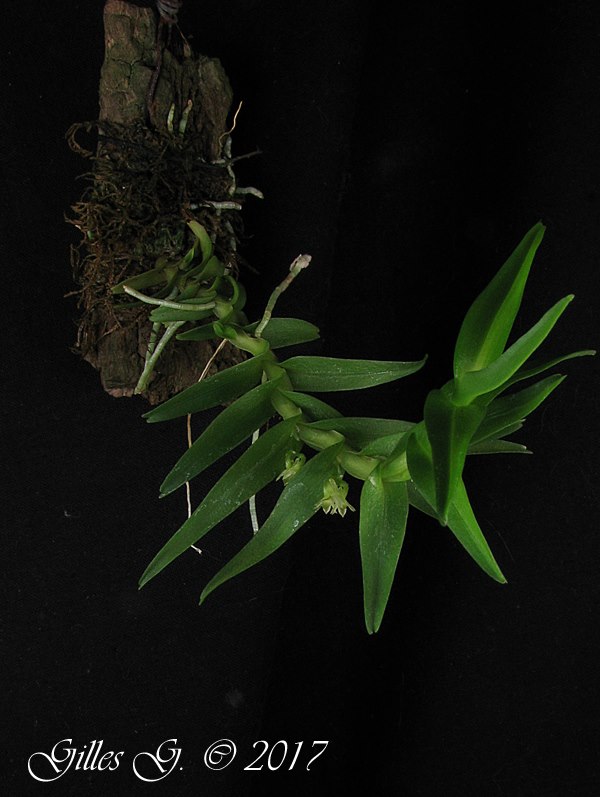
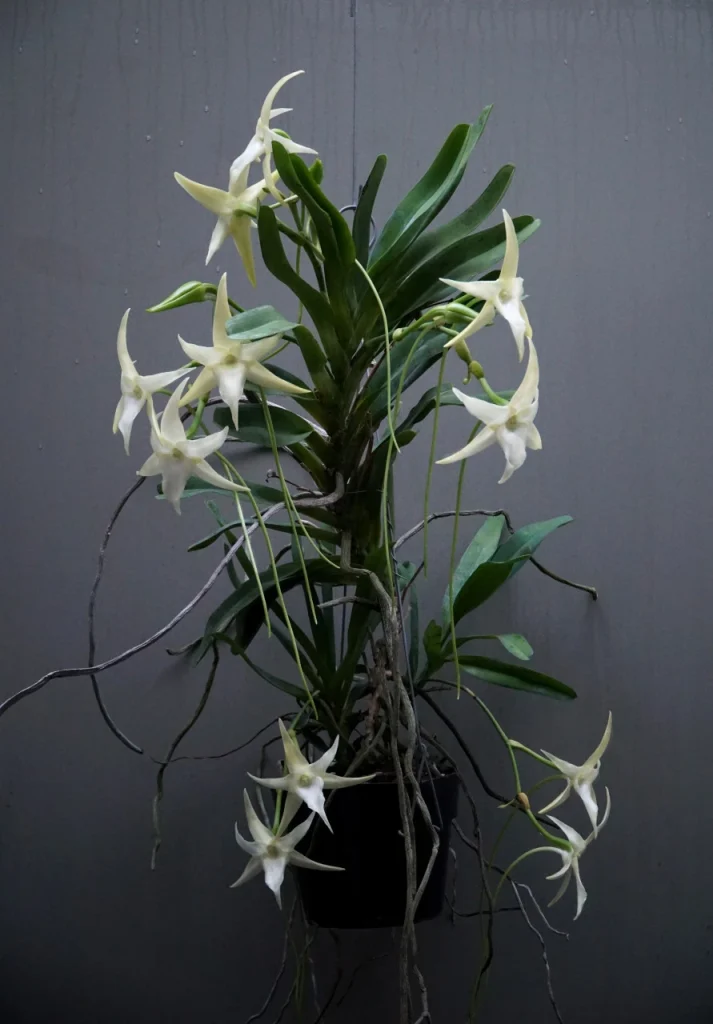
Growth habit: monopodial orchid that grows as an epiphyte (occasionally lithophytic) on tree trunks or rocks. The stem can reach about 1 m in length, bearing a single unbranched inflorescence.
Leaves: leathery, dark‑green, alternate along the stem, 22–30 cm long and about 3 cm wide, with a bilobed tip [5][8].
Inflorescence: erect to arching, 38–46 cm long (up to ~1 m in cultivated plants) and bearing 1–4 (rarely 6) flowers [6][5].
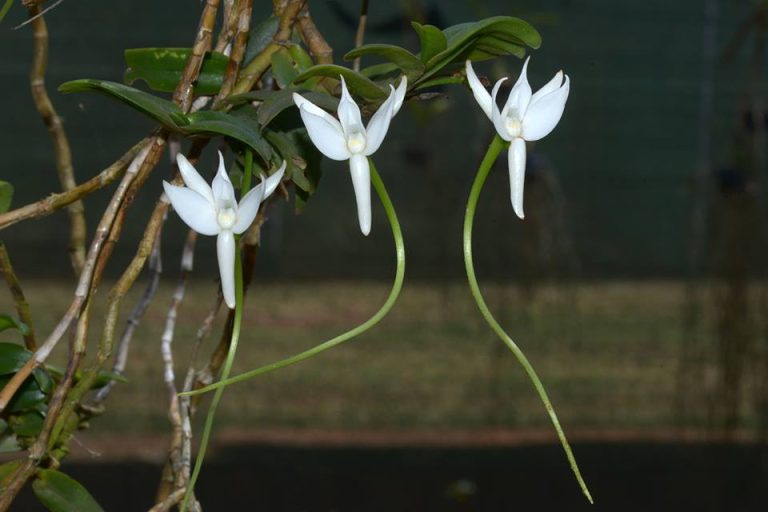
Flowers: creamy‑white, star‑shaped, 15–20 cm across; the labellum bears a tubular nectar spur 30–45 cm long, narrowing toward the tip. The flower emits a strong jasmine‑type fragrance at night [5][6][8].
These characters—especially the extreme spur length—distinguish it from other Angraecum species, although several Angraecum have white, star‑shaped flowers and a similar growth habit.
Native Range and Habitat
Native to the eastern and southeastern coast of Madagascar (Kew) [1]. In the wild it occurs in lowland coastal forests, often right at the forest edge where humidity is high and rainfall is heavy year‑round. Recorded elevations are from sea level to about 100 m (0–330 ft) [6][11]. The species grows as an epiphyte on trees but can also be lithophytic on moss‑covered rocks. The habitat is described as a hot, wet lowland environment with no pronounced dry season [11].
Species‑Specific Care
| Factor | Documented guidance | Source |
|---|---|---|
| Light | Bright shade; avoid direct midday sun. | [8][5] |
| Temperature | Day 20–27 °C, night 15–20 °C. | [8] |
| Humidity | Maintain ≥60 % relative humidity. | [8] |
| Watering | Frequent watering in summer; reduce frequency in cooler periods. | [8] |
| Medium | Well‑draining bark mix or sphagnum moss; mount on tree bark if desired. | [8] |
| Feeding | Weekly application of quarter‑strength liquid fertilizer during active growth. | [8] |
| Airflow | Good air circulation to prevent fungal buildup. | [8] |
| Seasonal changes | A cooler period (down to 15 °C night) is appreciated after flowering, but no strict rest period is required. | [8] |
Overall, the orchid thrives in a warm, humid environment that mimics its native lowland forest, with ample airflow and shade. Over‑watering or prolonged dry conditions are the most common causes of stress.
Flowering and Pollination
In cultivation in the northern hemisphere the plant typically flowers from November to May [6]. Flowers are long‑lasting and emit a strong jasmine fragrance at night, which attracts its natural pollinator: the hawkmoth Xanthopan morganii var. praedicta (formerly Xanthopan morganii praedicta) [5][6]. The moth’s proboscis matches the length of the orchid’s spur, confirming the classic co‑evolutionary hypothesis first proposed by Charles Darwin in 1862 and later confirmed by the discovery of the moth in 1903 [5][6].
Conservation and Responsible Cultivation
The IUCN Red List status for this species is listed as “Not Evaluated” by Kew’s database [5]. Wild populations are restricted to a narrow coastal strip of Madagascar, which is subject to habitat loss from deforestation and land‑use change. Cultivation from seed or tissue culture reduces pressure on wild plants; growers should source material from reputable, legally compliant nurseries.
Evidence and Limitations
Most morphological and ecological data come from reputable botanical institutions (Kew, Smithsonian Gardens, Cambridge University Botanic Garden) and a horticultural guide (OSCV). Precise elevation limits, detailed phenology across Madagascar’s micro‑climates, and long‑term population trends are not fully documented in the available sources. Cultivation recommendations are based on a single horticultural article; growers may need to adjust practices for local conditions.
FOLLOW THE EVIDENCE
Sources & references
- Angraecum sesquipedale Thouars | Plants of the World Online | Kew Science, https://powo.science.kew.org/taxon/urn:lsid:ipni.org:names:616416-1
- Darwin’s orchid | Kew, https://www.kew.org/plants/darwins-orchid
- Angraecum sesquipedale – Smithsonian Gardens, https://si.gardenexplorer.org/taxon-19788.aspx
- Angraecum sesquipedale – Cambridge University Botanic Garden, https://www.botanic.cam.ac.uk/the-garden/plant-list/angraecum-sesquipedale/
- Angraecum sesquipedale – OSCOV cultivation guide, https://oscov.asn.au/articles/angraecum-sesquipedale-by-hans-proebsting/
- The Wild Records for Angraecum Sesquipedale Point to a Hot, Wet Lowland Plant – Orchid Society, https://orchidsociety.com/the-wild-records-for-angraecum-sesquipedale-point-to-a-hot-wet-lowland-plant/