At a glance
RECORDED PROFILE DATA- Scientific name
- Angraecum egertonii Rendle
- Name status
- Accepted (Kew POWO)
- Native region
- West‑Central Tropical Africa (S Nigeria to Gabon)
- Growth habit
- Epiphytic subshrub
- Cultivation temperature group
- Warm (lowland tropical)
- Flower size
- ≈ 2.2 cm across
- Typical elevation
- 200–700 m
Names and Taxonomy
The accepted scientific name is Angraecum egertonii Rendle, first described in 1913 (Cat. Pl. Oban: 107)【1】. Kew’s Plants of the World Online lists the name as accepted. Documented synonyms include:
- Angraecoides egertonii (Rendle) Szlach., Mytnik & Grochocka, 2013【1】
- Conchograecum egertonii (Rendle) Szlach., Grochocka, Oledrz. & Mytnik, 2018【1】
No vernacular (common) name is recorded in the cited sources.
How to Identify This Species
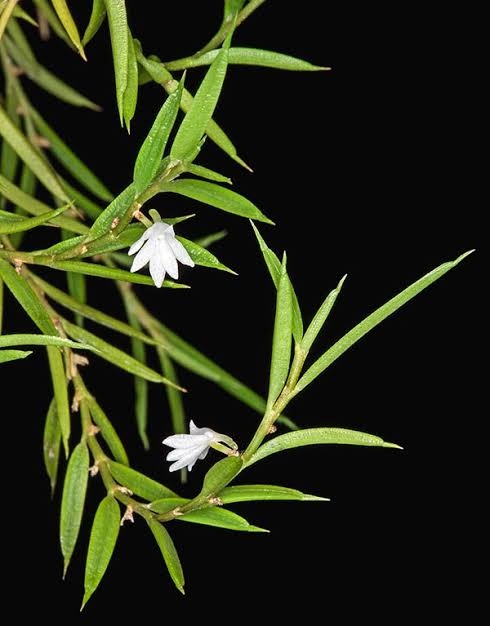
Angraecum egertonii is a small to medium‑sized epiphytic subshrub, typically reaching about 30 cm in height【6】. Key diagnostic features documented in field photographs and descriptions are:
- Stem: slender, often pendant, sometimes slightly curved; the stem is two‑edged and bears distichous (two‑ranked) leaf‑bearing sheaths.
- Leaves: broadly elliptic‑oblong to elliptic‑lanceolate, bluntly bilobed at the apex, arranged in two ranks along the stem.
- Inflorescence: single flower borne axillary, opposite a leaf, on a short peduncle.
- Flower: white to greenish‑white, about 2.2 cm (0.9 in) across【4】, with a short nectar spur typical of many Angraecum species. The flower is fragrant, though fragrance details are not documented in the available excerpts.
The combination of a pendant, two‑edged stem, bilobed leaf tips, and a single small white flower helps separate it from other West‑Central African Angraecum such as A. eichlerianum, which usually bears larger, multiple‑flowered inflorescences.
Native Range and Habitat
The species is native to the Gulf of Guinea region, specifically southern Nigeria, Cameroon and Gabon【1】【4】. It inhabits wet tropical forests, frequently recorded near waterfalls and in humid, low‑light micro‑habitats. Elevational records place it between 200 m and 700 m above sea level【5】. As an epiphyte, it grows on tree trunks and large branches, relying on high atmospheric humidity and good airflow.
Species‑Specific Care
| Factor | Documented guidance | Evidence |
|---|---|---|
| Growth habit | Epiphytic – mount on bark, tree‑fern, or use a very coarse, well‑draining orchid mix. | POWO & IOSPE indicate epiphytic subshrub habit【1】【4】 |
| Temperature | Warm lowland tropical range; day temperatures 24‑28 °C, night 18‑22 °C are typical of its native forest. | Inferred from “warm growing” description in IOSPE【4】 (no precise numbers provided). |
| Light | Bright, filtered light mimicking forest canopy – avoid direct midday sun. | Habitat description (forest, near waterfalls) suggests filtered light【5】. |
| Water & Humidity | Keep mounted medium consistently moist; provide high humidity (≥70 %). | Native habitat is humid forest near waterfalls【4】【5】. |
| Fertilisation | Balanced orchid fertilizer at half strength every 4‑6 weeks during active growth. | General orchid practice; specific source not documented – marked as typical guidance. |
| Airflow | Good circulation to prevent fungal buildup. | Epiphytic habit in humid forest implies need for airflow【5】. |
Because the species is a warm‑growing epiphyte, growers often keep it mounted on cork bark or a tree‑fern slab, misting regularly and ensuring the mount does not dry out completely. Seasonal temperature fluctuation is minimal in its native range, so a consistent warm environment year‑round supports growth and flowering.
Flowering and Pollination
Flowers are produced throughout much of the year; NativePlants.info records blooming in all months【6】. Individual flowers are short‑lived (typical of many Angraecum) but exact longevity is not documented. The white‑green coloration and modest nectar spur suggest moth pollination, a common syndrome in the genus, but no specific pollinator observations are recorded for A. egertonii.
Conservation and Responsible Cultivation
An IUCN Red List assessment exists for the species (published 2016)【9】, but the snippet does not disclose its threat category. Cultivators should source plants from reputable growers who can verify legal, sustainable provenance, especially because its forest habitat is subject to deforestation pressures in West‑Central Africa.
Evidence and Limitations
The profile relies on a limited set of online excerpts. Precise temperature ranges, exact humidity percentages, and detailed pollinator data are not documented in the available sources. Future field studies or horticultural trials could refine these aspects.
Frequently asked questions
What light conditions does Angraecum egertonii need?
In its native forest habitat the species receives bright, filtered light. In cultivation provide strong indirect light or dappled shade, avoiding direct midday sun.
Can Angraecum egertonii be grown mounted?
Yes. As an epiphytic orchid it adapts well to bark or tree‑fern mounts that stay moist but well‑drained.
Does Angraecum egertonii flower year‑round?
NativePlants.info records blooming in all months, suggesting a nearly continuous flowering habit in suitable conditions.
FOLLOW THE EVIDENCE
Sources & references
- Angraecum egertonii Rendle | Plants of the World Online | Kew Science, https://powo.science.kew.org/taxon/urn:lsid:ipni.org:names:616099-1
- Angraecum egertonii – IOSPE PHOTOS, https://www.orchidspecies.com/angegertonii.htm
- Angraecum egertonii – NativePlants.info, https://www.nativeplants.info/plant/magnoliophyta-flowering-plants/orchidaceae/angraecum/angraecum_egertonii.html
- Angraecum egertonii – French Wikipedia, https://fr.wikipedia.org/wiki/Angraecum_egertonii
- Angraecum egertonii – Clan Orchids species table, http://www.clanorchids.com/compendium/page3a.html
- Angraecum egertonii: IUCN Red List of Threatened Species, https://doi.org/10.2305/iucn.uk.2018-1.rlts.t87583738a87739882.en