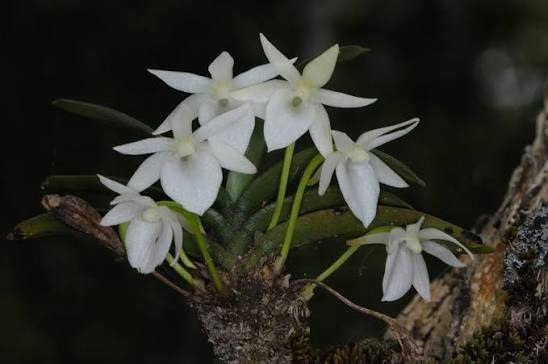
At a glance
RECORDED PROFILE DATA- Scientific name
- Angraecum cucullatum Thouars
- Name status
- Accepted (Kew POWO)
- Native region
- Réunion, Mauritius (Mascarene Islands)
- Growth habit
- Epiphytic subshrub
- Cultivation temperature group
- Not documented
Names and Taxonomy
The accepted scientific name for this orchid is Angraecum cucullatum Thouars. The name is listed as accepted by Kew’s Plants of the World Online (POWO) and is recorded in the International Plant Names Index (IPNI) as having been first published in Hist. Orchid. t. 48 (1822) [1][2]. POWO also cites an earlier publication in Nouv. Bull. Sci. Soc. Philom. Paris, sér. 2, 1: Tabl. Angorkis (1809) [1], reflecting historical differences in citation practices.
Several homotypic synonyms have been recorded, all referring to the same taxon:
- Aerobion cucullatum (Thouars) Spreng. (1826)
- Angorkis cucullata (Thouars) Kuntze (1891)
- Macroplectrum cucullatum (Thouars) Finet (1907)
- Perrierangraecum cucullatum (Thouars) Szlach., Mytnik & Grochocka (2013)
A heterotypic synonym, Angorkis cucullangis Thouars, also appears in older literature [1]. No infraspecific taxa (varieties or subspecies) are currently recognised.
Common names are scarce in the literature; a French vernacular “Angrec à capuchon” is listed in the French Taxref database [9], but it is not widely used in horticultural sources.
How to Identify This Species
Angraecum cucullatum is a miniature epiphytic orchid that forms a compact subshrub. The plant typically reaches about 30 cm in overall height in cultivation, with a short, thickened stem bearing 2–5 rigid, V‑shaped leaves that are ligulate and unequal‑bilobed at the apex [8][10].
The inflorescence is a slender raceme 3–4 cm long, bearing usually a single flower (occasionally up to two). The flower is white to green‑white, about 2 cm across, and bears a distinctive hood‑shaped labellum (the “cucullate” or cap‑like structure that gives the species its epithet) [10]. The labellum is three‑lobed, with the central lobe recurved, and a short nectar spur less than 1 cm long [10]. The fragrance is reported as pleasant and noticeable, especially at night [8][10].
Root systems are typical of epiphytic orchids: numerous fine aerial roots covered with a velamen layer, anchoring the plant to bark or other woody substrates.
Because several Angraecum species share a white, tubular flower, identification should also consider leaf morphology (rigid, V‑shaped leaves) and the unusually short spur, which distinguishes A. cucullatum from many congeners that possess long, slender spurs.
Native Range and Habitat
The species is native to the Mascarene Islands, specifically Réunion and Mauritius [1][4]. It occurs in the wet tropical biome, growing as an epiphyte on trees in humid forest habitats. POWO describes it as an “epiphytic subshrub” that prefers the moist, shaded conditions of lowland to mid‑elevation rainforests [1]. Precise elevation limits are not documented in the available sources.
Field observations recorded on the Réunion biodiversity portal (SINP) show the orchid occurs in at least seven communes across the island, with observations ranging from 1972 to 2017 [6]. This suggests a relatively widespread, though possibly fragmented, distribution within suitable forest patches.
Species‑Specific Care
| Factor | Documented guidance | Evidence |
|---|---|---|
| Light | Bright, filtered light mimicking forest canopy; avoid direct midday sun. | General epiphytic habit inferred from native forest environment [1][8] |
| Water | Keep medium evenly moist; water regularly during active growth, allowing brief surface drying between waterings. | Low drought tolerance noted [8] |
| Humidity | High humidity (70 % + ) recommended to reflect wet tropical forest conditions. | Habitat description (wet tropical biome) [1] |
| Temperature | Not documented for this species; typical Mascarene lowland temperatures range from 20 °C to 30 °C. | Not documented |
| Substrate / Mounting | Prefer bark‑based orchid mix or mounting on cork/bark; provides good aeration for aerial roots. | Epiphytic habit [1][8] |
| Fertilizer | Apply a balanced, water‑soluble orchid fertilizer at half strength every 2‑4 weeks during growth. | Standard orchid practice; no species‑specific source. |
| Repotting / Re‑mounting | Repot when roots outgrow the container, typically every 2‑3 years, using fresh bark mix. | General recommendation; not species‑specific. |
| Seasonal changes | Not documented; observations indicate year‑round blooming in cultivation [8]. | Not documented |
Because the species is listed as having “low drought tolerance,” growers should avoid prolonged dry periods and ensure good air movement to prevent fungal problems on the velamen‑covered roots. No specific rest period has been reported for A. cucullatum, so maintaining moderate, consistent conditions is advisable.
Flowering and Pollination
In cultivation, A. cucullatum is reported to flower throughout the year, with a possible peak in late spring to early summer in the Southern Hemisphere [8][10]. Flowers are short‑lived, lasting a few days, and emit a noticeable fragrance, especially in the evening, suggesting nocturnal pollinator activity.
Pollination biology for this species has not been documented in the available literature. The short spur (< 1 cm) and nocturnal scent are consistent with moth pollination in many Angraecum species, but direct observations are lacking, so any pollinator assignment remains speculative.
Conservation and Responsible Cultivation
POWO includes a predictive extinction‑risk assessment that classifies Angraecum cucullatum as “Threatened” with low confidence [4]. This reflects the limited distribution of the species on the Mascarene islands and ongoing habitat pressures such as forest fragmentation.
Collectors are encouraged to obtain plants from reputable, legally compliant nurseries that propagate material ex‑situ rather than harvesting from wild populations. Supporting in‑situ conservation programs on Réunion and Mauritius can also help preserve remaining natural habitats.
Evidence and Limitations
The profile relies on taxonomic and distribution data from Kew’s POWO, nomenclatural records from IPNI, and limited horticultural observations from NativePlants.info and a Grokipedia summary. Detailed measurements of flower size, spur length, and phenology are drawn from the Grokipedia excerpt, which does not provide a primary‑source citation; therefore these values should be treated as provisional.
Key gaps include:
- Precise elevation range and microhabitat preferences in the wild.
- Documented temperature tolerances and any seasonal rest period.
- Verified pollinator observations and seed set data.
- Formal IUCN Red List assessment; the “Threatened” status is a predictive model, not an official evaluation.
Further field studies and cultivated trials are needed to refine care recommendations and confirm ecological traits.
Frequently asked questions
Is Angraecum cucullatum considered endangered?
Predictive modelling listed by Kew’s Plants of the World Online classifies the species as Threatened (low confidence). No formal IUCN Red List assessment is currently available.
Can I grow Angraecum cucullatum at home?
Yes, but care should reflect its natural epiphytic habit: bright filtered light, high humidity, regular watering, and a well‑draining bark medium. Specific temperature limits are not documented, so maintaining moderate tropical temperatures (20‑30 °C) is advisable.
When does this orchid flower?
Cultivated plants have been reported to flower throughout the year, with a peak in late spring to early summer in the Southern Hemisphere.
FOLLOW THE EVIDENCE
Sources & references
- Angraecum cucullatum Thouars | Plants of the World Online | Kew Science, https://powo.science.kew.org/taxon/616058-1
- Angraecum cucullatum Thouars | International Plant Names Index, https://ipni.org/n/616058-1
- Angraecum cucullatum – NativePlants.info, https://www.nativeplants.info/plant/magnoliophyta-flowering-plants/orchidaceae/angraecum/angraecum_cucullatum.html
- Angraecum cucullatum – Wikipedia, https://en.wikipedia.org/wiki/Angraecum_cucullatum
- Angraecum cucullatum – Grokipedia, https://grokipedia.com/page/angraecum_cucullatum
- Angraecum cucullatum – Atlas SINP de La Réunion, https://geonature.borbonica.re/atlas/espece/705831
- Revision of Angraecum sect. Perrierangraecum (Orchidaceae; Epidendroideae; Vandeae) for the Mascarenes, Phytotaxa 2020, https://phytotaxa.mapress.com/pt/article/view/phytotaxa.442.3.4