At a glance
RECORDED PROFILE DATA- Scientific name
- Angraecum dryadum Schltr.
- Name status
- Accepted name
- Native region
- Madagascar
- Growth habit
- Epiphytic subshrub
- Cultivation temperature group
- Cool‑growing
Names and Taxonomy
The accepted scientific name for this species is Angraecum dryadum Schltr.1. The name was first published in 1925 in Repertorium Specierum Novarum Regni Vegetabilis Beih.2. A later synonym is Perrierangraecum dryadum (Schltr.) Szlach., Mytnik & Grochocka, published in 20131. No common names are documented in the available sources.
How to Identify This Species
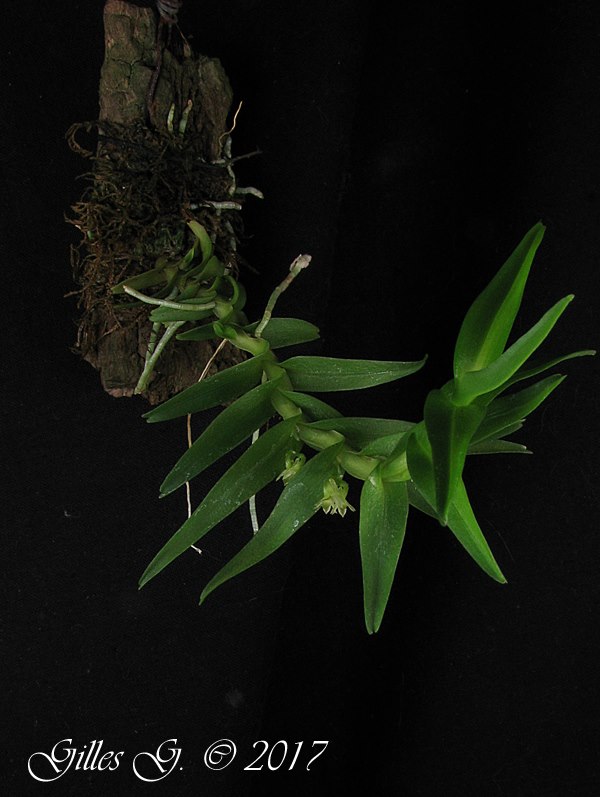
Angraecum dryadum is a medium‑sized epiphytic subshrub that typically reaches about 30 cm in height4. The plant bears 7–10 linear leaves, each roughly 35–38 mm long and 1.3–2.2 mm wide3. Roots are aerial and attach to bark or lichen‑covered branches.
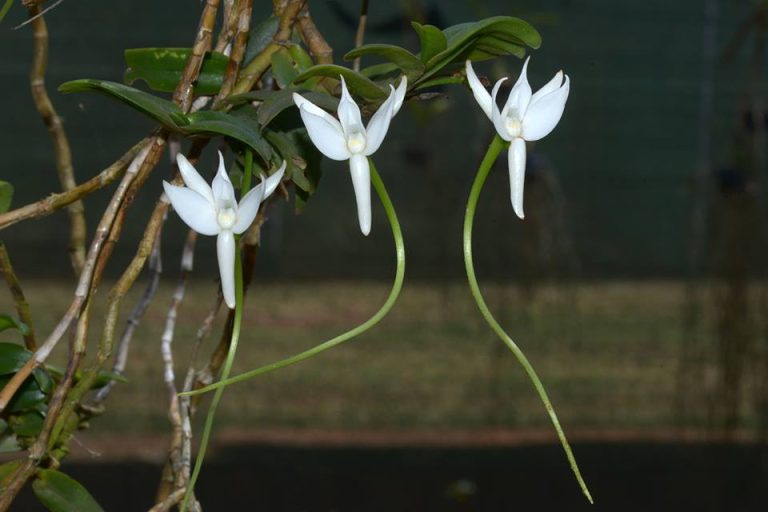
The inflorescence is axillary, bearing a few flowers that appear in spring through summer in the wild3. Flowers are white to greenish‑white, fragrant, and measure approximately 6 cm (2.4 in) across3. The lip is modestly sized, and the nectar spur is relatively short, consistent with other members of the section Perrierangraecum.
Because many Angraecum species share a similar habit, reliable identification should be confirmed by flower morphology (size, lip shape, spur length) and by the altitude of the collection site (1,000–2,100 m).
Native Range and Habitat
The species is endemic to Madagascar1. In its natural setting it grows as an epiphyte in humid, lichen‑rich evergreen forests at elevations between 1,000 and 2,100 m3. These montane forests are characterised by cool temperatures, high humidity, and filtered light beneath the canopy.
Species‑Specific Care
| Factor | Documented guidance | Source |
|---|---|---|
| Growth habit | Epiphytic; mount on bark or grow in a coarse, well‑draining medium | 1, 3 |
| Temperature | Cool‑growing; prefers moderate temperatures typical of 1,000–2,100 m (≈15–25 °C) | 3 |
| Light | Bright, filtered light; avoid direct midday sun | Not documented |
| Watering | Keep medium moist but allow quick drying between waterings; high humidity beneficial | Not documented |
| Humidity | High humidity (≥70 %) mimicking montane forest conditions | Not documented |
| Fertilisation | Balanced orchid fertilizer applied at reduced strength during active growth | Not documented |
| Seasonal changes | Provide slightly cooler temperatures and reduced watering in the cooler months to simulate natural seasonality | Not documented |
Growers report that the plant is sensitive to drought and prefers consistent moisture, matching its native humid environment4. Because it is a cool‑growing species, it should not be placed in hot, low‑elevation greenhouse conditions.
Flowering and Pollination
In the wild, Angraecum dryadum flowers in the spring to early summer months3. Individual flowers are long‑lasting and emit a noticeable fragrance, especially in the evening, suggesting moth pollination, although specific pollinator observations are not documented.
Conservation and Responsible Cultivation
No formal conservation assessment is provided in the available sources. As an endemic species of Madagascar’s montane forests, it may be vulnerable to habitat loss, and cultivation from wild‑collected material should be avoided.
Evidence and Limitations
Key aspects such as precise temperature ranges, light intensity, watering frequency, and pollinator identity are not fully documented for this species. The care recommendations are therefore based on the limited horticultural notes available and on inference from its native high‑elevation habitat.
Frequently asked questions
What temperature range does Angraecum dryadum prefer?
It is described as a cool‑growing species, thriving at temperatures typical of its native 1,000–2,100 m elevation (approximately 15–25 °C).
When does Angraecum dryadum flower in its natural habitat?
In the wild it produces flowers in the spring through early summer.
Are the flowers of Angraecum dryadum fragrant?
Yes, the flowers emit a noticeable fragrance, especially in the evening.
FOLLOW THE EVIDENCE
Sources & references
- Angraecum dryadum Schltr. | Plants of the World Online | Kew Science, https://powo.science.kew.org/taxon/urn:lsid:ipni.org:names:616092-1
- Angraecum dryadum | International Plant Names Index, https://www.ipni.org/n/616092-1
- IOSPE PHOTOS Angraecum dryadum, http://www.orchidspecies.com/angdryadum.htm
- Angraecum dryadum (NativePlants.info), https://www.nativeplants.info/plant/magnoliophyta-flowering-plants/orchidaceae/angraecum/angraecum_dryadum.html